




Introduction
Most people who start project writing begin in the same way: “I’ll fill in the form, write nicely, add a few fancy buzzwords.” Then the result comes: rejection. Motivation drops and the sentence appears: “These programmes must be political.” In reality, the problem is usually not politics but perception. A project proposal is not a piece of creative writing; it is a decision-making document. Evaluators do not fund good intentions, they fund convincing logic. This article explains, in plain language, how a junior project writer can grow into a senior one, step by step. At the end, you will also find a short self-assessment test to answer one key question: Where am I right now?

Section 1: The Junior Phase – Not “I’m Writing”, but “I’m Learning”
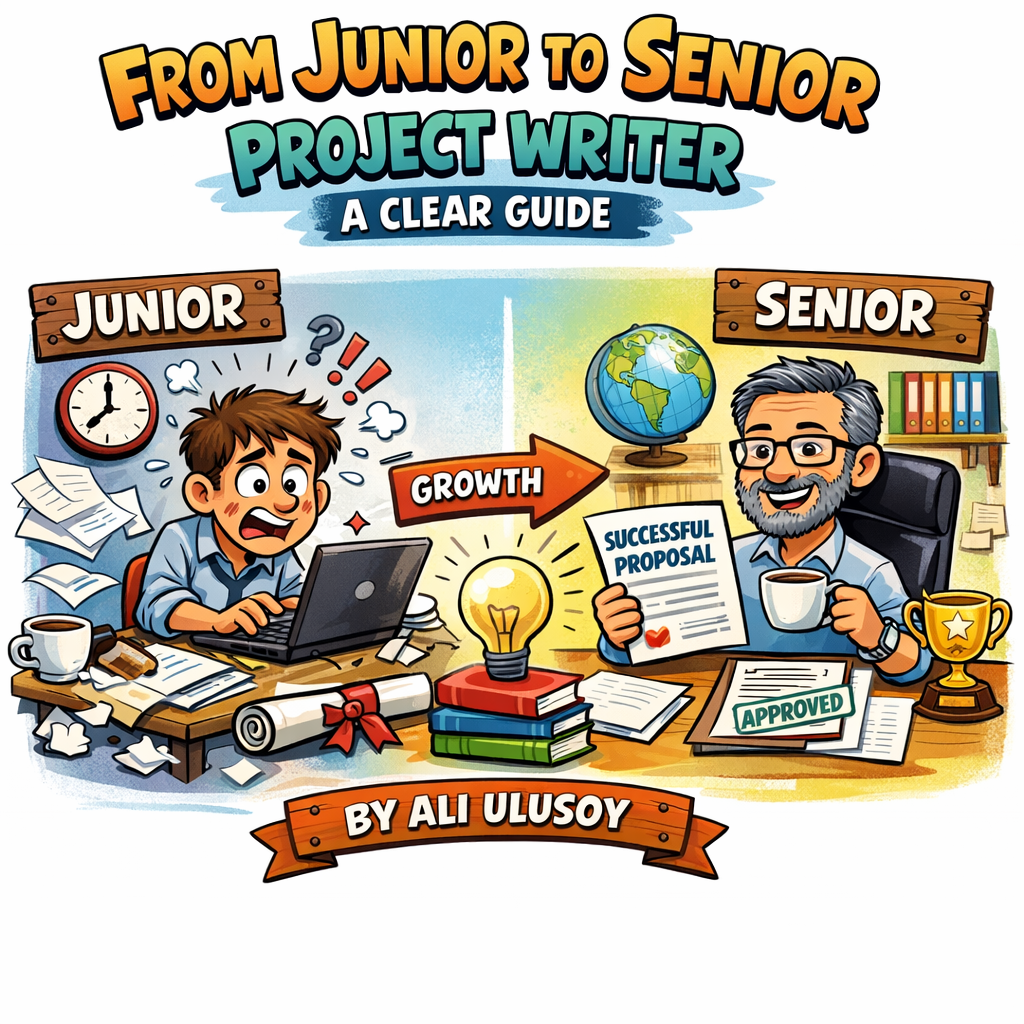
Being a junior project writer is not a weakness; it is the most valuable phase of the journey. This is where habits are formed. Build the right ones and progress accelerates; build the wrong ones and you may stagnate for years. The biggest trap at junior level is thinking that project writing is about producing nice text. It is not. A project starts with problem analysis and continues with solution design. The most important muscle to develop at this stage is needs analysis. Saying “young people are unemployed” is meaningless unless you explain which young people, where, how many, and why. A junior writer’s goal should not be to complete an entire proposal alone, but to write one section well and clearly explain why that section deserves points. At this stage, “I wrote it” matters far less than “I understand the logic behind it.”

Section 2: The Mid-Level Phase – From Text Producer to Structure Builder
The transition from junior to mid-level happens when writing turns into structuring. A mid-level writer no longer produces isolated paragraphs; they build a coherent chain between objectives, activities, outputs and results. This is where the rules change. Measurability becomes central. Evaluators are not impressed by ambitious wording; they want to see concrete change and evidence that it can be measured. A mid-level writer can clearly state how many people will benefit, what will change for them, and how that change will be verified. Partnership design also becomes more serious at this stage. It is no longer enough to say “we have partners from different countries.” Each partner must have a clear role that makes sense within the solution. At mid-level, proposals start to feel reliable, and evaluators begin to think: This team can actually deliver.

Section 3: The Senior Phase – Writing Ends, Project Architecture Begins
A senior project writer is not senior because they write faster. They are senior because they think strategically. When reading a call, they immediately ask: What is the real problem behind this call? What kind of project would deserve funding? Which partners would make it credible? At this level, the evaluator mindset dominates every sentence. Senior writers constantly ask themselves: Does this sentence earn points? Sustainability is no longer a vague promise but a mechanism. What continues after the project ends? Who takes ownership? Which outputs become part of regular practice? Impact is no longer a final section; it is embedded throughout the proposal. A defining trait of a senior writer is this: when a proposal is rejected, they can usually predict why; when it is accepted, they know exactly what worked.

Section 4: What Really Accelerates the Transformation: Systems, Not Luck
Progress in project writing does not come from writing many proposals, but from writing them within a learning system. The basic cycle is simple: write, measure, improve, rewrite. After each submission, take time to analyse what worked and what did not. Where did points drop? Which arguments were weak? Carry those lessons into the next proposal deliberately. Portfolio building is another accelerator. Each project is not just a line on a CV, but evidence of growth. Mentorship also plays a key role. Understanding why a senior writer chooses certain formulations can save months, sometimes years. Finally, specialisation matters. Trying to write for every programme slows progress; mastering one or two programmes speeds it up dramatically.
Self-Assessment Test: “Where Am I on the Junior–Senior Scale?”
Answer each question with Yes or No, then count your “Yes” answers.
-
After reading a call, I can clearly judge whether a project idea truly fits it.
-
I use at least one reliable data source (national or EU-level) in my needs analysis and integrate it naturally into the text.
-
I write objectives that are measurable, including numbers and expected change.
-
I can build a clear objectives–activities–outputs–results chain without breaks.
-
I can explain why each partner is needed and what they uniquely contribute.
-
I describe risks realistically and avoid presenting projects as risk-free.
-
My dissemination plans clearly define target groups, channels and numbers.
-
I describe sustainability as a concrete mechanism, not just a good intention.
-
I can reread my proposal with an evaluator’s eye and identify weak sentences.
-
After each submission, I prepare a short lessons-learned note for the next one.
How to Interpret Your Score
0–3 Yes: Junior starting point. Core muscles are still developing.
4–7 Yes: Mid-level threshold. Structure is emerging, systems need strengthening.
8–10 Yes: Senior level. Project architecture and evaluator logic are in place.
If you want, I can turn your score into a 30-day personalised development plan showing exactly which skills to strengthen, what to read, and what to practise each week.